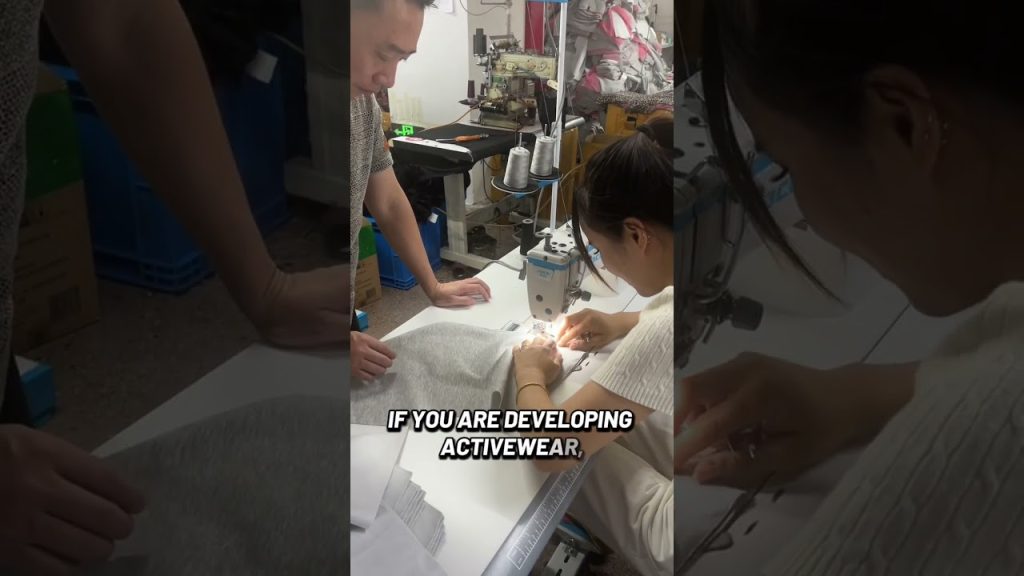



How an Activewear Manufacturer Brings a New Decoration Technique Into 86,000-Piece Bulk Production
When a brand adds a new design detail, production consistency becomes the key challenge. A rhinestone decoration that looks perfect in a hand-made sample can drift badly across thousands of pieces if the technique is not controlled.
HF Garments is a <a href="https://haofenggarments.com/bulk-leggings-manufacturer-pre-sewing-checks/">leggings manufacturer</a> currently introducing a new rhinestone application process for leopard leggings and running it as part of an 86,000-piece production order for the US market. This article explains the five-gate process behind that introduction—the same logic an <a href="https://haofenggarments.com/how-to-choose-an-activewear-manufacturer/">activewear manufacturer</a> should use to protect consistency on any new decoration technique.
Why "Sample Looks Good" Is Not the Real Test
A lot of activewear brands focus on design. Scaling from samples to bulk production is where suppliers often fail. A decoration technique that works on one piece rarely transfers to 86,000 by itself. The difference is process control: stable pressure, accurate placement, and a team trained to check every piece against the approved standard.
For an activewear manufacturer, the question for a buyer is not "can you add this decoration?" It is "how do you make sure the decoration stays consistent when the order goes from 1 sample to 86,000 pieces?"
Gate 1 — Machine & Technique Setup (Pneumatic Heat Press)
For a new rhinestone application, we use pneumatic heat press equipment. It provides stable pressure, accurate placement, and consistent finishing quality during bulk production.
Why pneumatic matters: manual pressing puts pressure in the machine operator's hands, which drifts from piece to piece. A pneumatic system removes that variable. Beyond the machine, before starting a large order, our team carefully tests and confirms every production detail—temperature, pressure, dwell time, and stone placement.
This first gate is about locking the process before the line starts, not fixing it after.
Gate 2 — Employee Training & Quality Check
New techniques never go straight to the bulk line. Our production supervisors work together with operators to review the process, check the rhinestone position, and make sure every piece meets the required standard.
New techniques always pass through three stages before bulk manufacturing:
- Sample approval — the decoration is approved against the buyer's standard
- Process adjustment — the machine and material settings are tuned for this specific style
- Team training — both supervisors and operators are trained on the approved process and checkpoints
This is how an activewear manufacturer turns a new design into a repeatable production step, rather than a one-off sample.
Gate 3 to 5 — Bulk Production, Control, and On-Time Delivery
After the technique is approved and the team is trained, the line can scale. This leopard leggings project is part of an 86,000-piece bulk order for the US market. The team is working to complete production and prepare shipment before the end of August.
The value for a buyer is not just that the factory can make 86,000 leggings. It is that the decoration stays consistent from piece one to piece 86,000, and that the shipment leaves on time—because the process was controlled before volume started.
<a href="https://haofenggarments.com/color-consistency-sample-to-bulk-production/">Color consistency from sample to bulk</a> and <a href="https://haofenggarments.com/how-to-tell-clothing-manufacturer-real-production-capacity/">verifying a factory's real production capacity</a> are the two questions buyers most often get wrong before placing a bulk order—both come back to whether the factory controls its process.
FAQ
1. How do I choose a reliable activewear manufacturer?
Look beyond price and catalog. Check whether the factory has a documented process for taking a new design or decoration from sample to bulk, how it controls consistency at scale, and whether it can show real production evidence such as current orders, machinery, and quality-check routines. Ask what happens if quality fails before shipping, not just what the factory promises.
2. What should brands prepare before bulk activewear production?
A brand should provide the approved sample, the decoration or construction specification, the quality standard for every piece, and the expected bulk-order plan. The clearer the approved standard, the easier it is for the factory to lock the process and keep every piece consistent.
3. How does a manufacturer ensure quality consistency?
Through process control, not just inspection. A reliable activewear manufacturer uses controlled equipment (such as pneumatic heat press for stable pressure), a written process, sample approval before bulk, trained supervisors and operators, and checkpoints that review position and finish against the approved standard during the run.
4. What is the process from sample to bulk production?
The process is: confirm the design and standard → set up and test the technique → approve the sample → adjust the process → train the team → scale into bulk with checkpoints → control quality and delivery through to shipment. Each stage is a gate, not a formality.
CTA
At HF Garments, we help activewear brands turn creative designs into reliable bulk production. From sample development to large-scale manufacturing, we support brands with quality control and stable delivery.
Ready to discuss a new product or decoration technique? Talk to our team: Request a quote