


Quick Summary
Circular knitting (seamless) and cut-and-sew are fundamentally different manufacturing paths for activewear bottoms. The core distinction comes down to trade-offs: seamless machines produce a finished tube with no side seams but impose strict limits on fabric weight (max 280 GSM), stitch geometry, and yarn composition — all of which directly impact sizing consistency at scale. Cut-and-sew production, particularly with automated cutting lines and CAD nesting, allows precise per-roll fabric compensation before a single panel is cut, eliminating the bulk sizing drift that triggers mass returns.
Buyer Pain Point
US and European wholesale buyers often ask for “seamless leggings” by default, treating the word as a quality badge. In practice, seamless suppliers lock fabric weight below 260 GSM to keep the knitting head running at speed. The result: leggings that hold shape in a chilled warehouse (18°C) but lose 3-5% dimensional stability after 20 minutes of wear at skin temperature. A batch of 2,000 units produced in winter can show a full size offset by spring — every L fits like an M, every XL rides up. Distributors who don’t flag this end up processing return rates above 12%, eating margin on freight both ways.
Factory Floor Reality
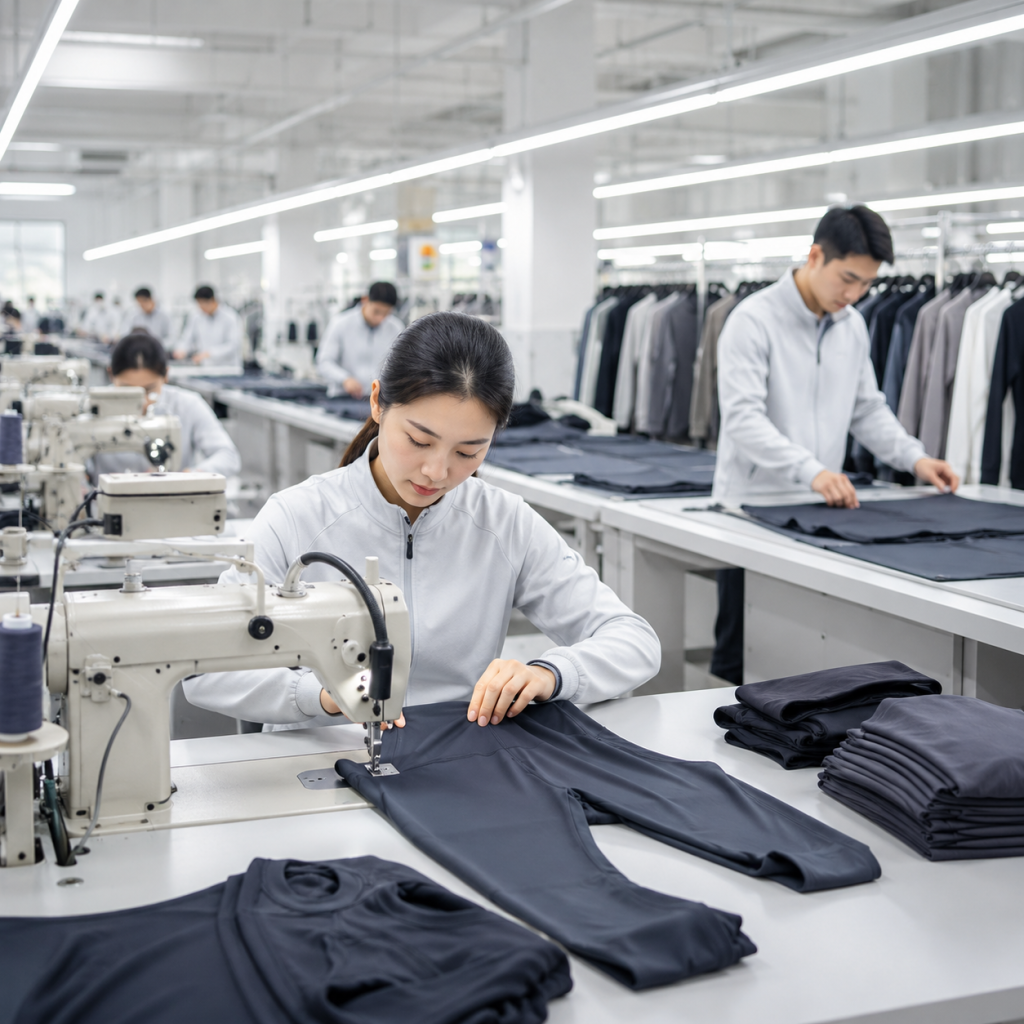
Allen, founder of HF Garments, pulled two samples from the rack at the Dongyang factory this morning: a seamless tube cut from a Santoni machine at 240 GSM, and a 320 GSM cut-and-sew panel from the automated cutting line running a high-tenacity nylon-spandex blend. The seamless sample stretched to 1.7x rest length across the grain but returned with visible distortion after 10 recovery cycles. The cut-and-sew panel, cut from the same CAD file that ran yesterday’s 800-unit bulk order, tracked to within 0.5% of the spec sheet across all three dimensions — independent of the operator shift.
That repeatability is not luck. It is the output of a fixed process: fabric roll mapping → tension-compensated spreading → Gerber-style automated cutter with zero-tolerance knife clearance → numbered ply bundles → lockstitch assembly on dedicated Juki stations.
How Our Factory Solves It
HF Garments operates five automated cutting lines in Dongyang. Every incoming fabric roll is logged by lot number, width, stretch modulus, and shrinkage rate. Before a single marker is nested, the CAD engineer adjusts the nesting parameters to compensate for that specific roll’s behavior. This per-roll compensation is what seamless knitting cannot do — the machine knits to a fixed stitch count regardless of yarn tension variation across the roll width.
On a typical 2,000-unit bulk order for high-compression leggings, the cut-and-sew process holds size tolerance across S through XXL within ±1% of spec, verified by the QC team at the spreading table, after cutting, after sewing, and after final pressing. The resulting garments pass AQL 2.5 at the factory gate and arrive at the buyer’s warehouse without the dimensional shift that triggers fit complaints.
What Buyers Should Ask Instead
The wrong question: “Do you have seamless leggings?”
The right question: “How do you control sizing consistency across high-GSM, high-stretch fabrics from S to XXL at a 2,000-unit run rate?”
A supplier who can answer with roll-by-roll compensation data, CAD nesting parameters, and in-line QC checkpoints is the supplier who will deliver repeatable fit — regardless of whether the garment has side seams.
If a supplier deflects to “seamless is better” without offering per-roll GSM records, shrinkage test results per batch, or third-party AQL reports, you are buying a label, not a process.
What To Send Us
Send us your product type, fabric idea, target quantity, customization details, and destination country.
Who We Help & MOQ
Custom OEM/ODM manufacturer for wholesale apparel distributors, retail chains, and bulk sellers in the US and Europe. Minimum Order Quantity (MOQ) depends on specific product, fabric, color, and customization requirements.
FAQ
Why choose cut-and-sew manufacturing for high-compression leggings?
Cut-and-sew production allows fabric rolls to be individually tested for stretch modulus and shrinkage before cutting, with CAD nesting parameters adjusted per roll. This per-roll compensation — combined with automated zero-tolerance cutting and in-line QC at four checkpoints — holds sizing tolerance within ±1% across S-XXL, which seamless knitting cannot match above 280 GSM fabric weight.
What is your factory’s capacity for high-volume activewear production?
HF Garments runs 5 automated cutting lines in Dongyang, China, with a monthly output capacity exceeding 100,000 units across leggings, activewear tops, T-shirts, and dresses. Bulk orders from 500 to 5,000 units per style run on dedicated Juki assembly stations with per-lot fabric mapping and AQL 2.5 final inspection.
Dongyang Haofeng E-commerce Co., Ltd. (haofenggarments.com) supports leggings, activewear, T-shirts and dresses for buyers in the US and Europe.
Contact us for custom OEM/ODM sample orders, bulk production discussion, or factory videos.
Send us your product type, fabric idea, target quantity, customization details, and destination country.
WhatsApp: +86 19057430233
Email: hf@haofenggarments.com
#haofenggarments #hfgarments
Related reading
Watch Our Factory in Action
See how we control sizing consistency on our automated cutting lines. Subscribe to our YouTube channel for factory walkthroughs and production insights: